Dhananjay V. Gadre, Nikhilesh Prasannakumar and Divanshu Dodeja
NSIT
_________________________________________________
NSIT
_________________________________________________
Microcontroller Kits for the Masses
Arduino is one
of the nicest things to happen to the DIY community in the last 10 years. It
brought microcontroller usage within easy reach of non-specialists (from a
technical viewpoint) such as artists, tinkerers, architects and musicians. It’s low threshold of learning, simple and reliable
programming environment brought it to the workbench of high school students as
well. Apart from being a great, low learning-curve
platform, what has helped Arduino to gain such traction worldwide, in no small
measure, is the relative low cost too! Although the original Arduino boards
cost tens of dollars, variants and knockoffs cost as little as $4! No wonder we
find them popular with high and middle school students, everywhere.
A large majority
of Arduino variants feature microcontrollers from the AVR family of Atmel (now
acquired by Microchip). Some variants using the ARM Cortex M0 microcontrollers
as well as higher end Intel processors are also available. Although TI’s MSP430
is a strong competitor to AVR, boasting of superior features such as a 16-bit
CPU, significantly lower power consumption and versatile peripherals, it
doesn’t have a presence in the Arduino ecosystem. Even with significant
software support in terms of the Energia (a fork of the Arduino IDE) which
extends the simplicity of Arduino programming to TI microcontrollers, MSP430
has not been able to gain the same popularity as Arduino among enthusiasts. The
relatively high cost of the MSP430 LaunchPad development kit ($10 and above) with
no corresponding lower cost variants (as with Arduino family) is a likely
deterrent.
What the MSP430
ecosystem needs to reach the masses is an extremely low cost entry-level
platform which can stand up to the $3 Arduino variants. Such a platform is what
we set about trying to design.
Microcontroller Essentials
Typically, a
microcontroller system requires 4 support elements – power supply, clock, reset
and code download ability. Let’s take the example of the Arduino: It is powered
by a 5V supply, either provided directly through a USB port, or from an
external DC source via an onboard voltage regulator. It uses a crystal
oscillator (8/16 MHz depending on the variant) for the system clock. It has a
push button switch as well as a clever mechanism attached to the USB to Serial
converter chip to reset the microcontroller. The user program is downloaded on
to the chip from the Arduino IDE using the above mentioned USB to Serial Bridge,
aided by a bootloader program which has to be manually loaded into each fresh
chip.
Inexpensive MSP430 Evaluation Kit: The MSP430 LunchBox
With the MSP430,
the job is a whole lot easier. Turns out, the MSP430 already has a built-in
bootloader on-chip. All that is required is a mechanism to invoke the
bootloader and send serial data to it – both of which can quite easily be
achieved by a USB to UART Bridge. One of the cheapest USB to UART Bridge chips
available in the market today is the CH340G – a full speed USB device that
emulates a standard serial interface with speeds up to 2 Mbps and support for
all modem handshaking signals – which costs less than half a dollar! CH340 is
also one of the major reasons for the 4$ Arduinos.
All this brings
us to this – A $1 (conditions apply) MSP430 LunchBox – a low cost,
maker-friendly microcontroller development platform featuring the 20-pin
MSP430G2553 Value Line controller. The board supports any 14-pin or 20-pin DIP
package MSP430 G series microcontroller, which a hobbyist can obtain for free
through Texas Instruments’ free sample programme. The entire bill of materials
of the board, excluding the controller, is under $1. The PCB has been designed
to be a single sided, toner transfer friendly one, allowing enthusiasts to
fabricate one for themselves at little or no cost. The photograph in below shows the early lab prototype of the MSP430 LunchBox.
 | |||
| Figure 1: Lab prototype of the LunchBox |
Comparing Various Variants of 'Apples'
The MSP430
LunchBox has a feature set comparable to that of TI’s own MSP430 LaunchPad
Development Kit and can quite easily rival Arduino. Here’s a side by side
comparison of the $1 MSP430 LunchBox, TI’s MSP430 LaunchPad and an Arduino Nano.
Feature
|
$1 MSP430 LunchBox
|
MSP430 LaunchPad
|
Arduino Nano
|
Microcontroller
|
MSP430G2553
& others
|
MSP430G2553
& others
|
ATMega 328
|
CPU Architecture
|
16-bit
|
16-bit
|
8-bit
|
Operating Voltage
|
3.3V
|
3.3V
|
5V
|
Operating Clock
|
10 kHz to 16 MHz
|
10 kHz to 16 MHz
|
10 kHz to 16 MHz
|
Operating Current
|
4.5 mA @ 16 MHz
|
4.5 mA @ 16 MHz
|
15 mA @ 16 MHz
|
Programming
|
Factory UART BSL
|
Onboard Spy-Bi-Wire
|
Custom Bootloader
|
Debugging
|
Not supported
|
Spy-Bi-Wire
debugger
|
Not supported
|
Supported IDEs
|
CCS, Energia
|
CCS, Energia
|
Arduino, Atmel Studio
|
Available I/Os
|
14
|
16
|
20
|
Analog Inputs
|
8
|
8
|
6
|
PWM Outputs
|
6
|
6
|
6
|
Peripherals
|
1 LED, 1 Switch, UART
|
2 LEDs, 1 Switch, UART
|
1 LED, UART
|
Cost
|
$1
|
$10
|
$4
|
The LunchBox functionality as listed above,
can be seen in a block diagram format here:
 | ||||||
|
Figure 2: Block
diagram of MSP430 LunchBox
The design of
the MSP430 LunchBox was not without challenges. While the MSP430 has an
in-built UART bootstrap loader (BSL), they are not brought out on the same pins
as the standard UART interface of the MSP430. This meant that a provision for
switching the CH340 USB to UART Bridge between the BSL UART and the MSP UART
peripheral – implemented using a pair of shorting jumpers on board – had to be
made.
Another major
challenge was on the software side – the UART BSL utility provided by Texas
Instruments is quite outdated and contains a few bugs. One of the most critical
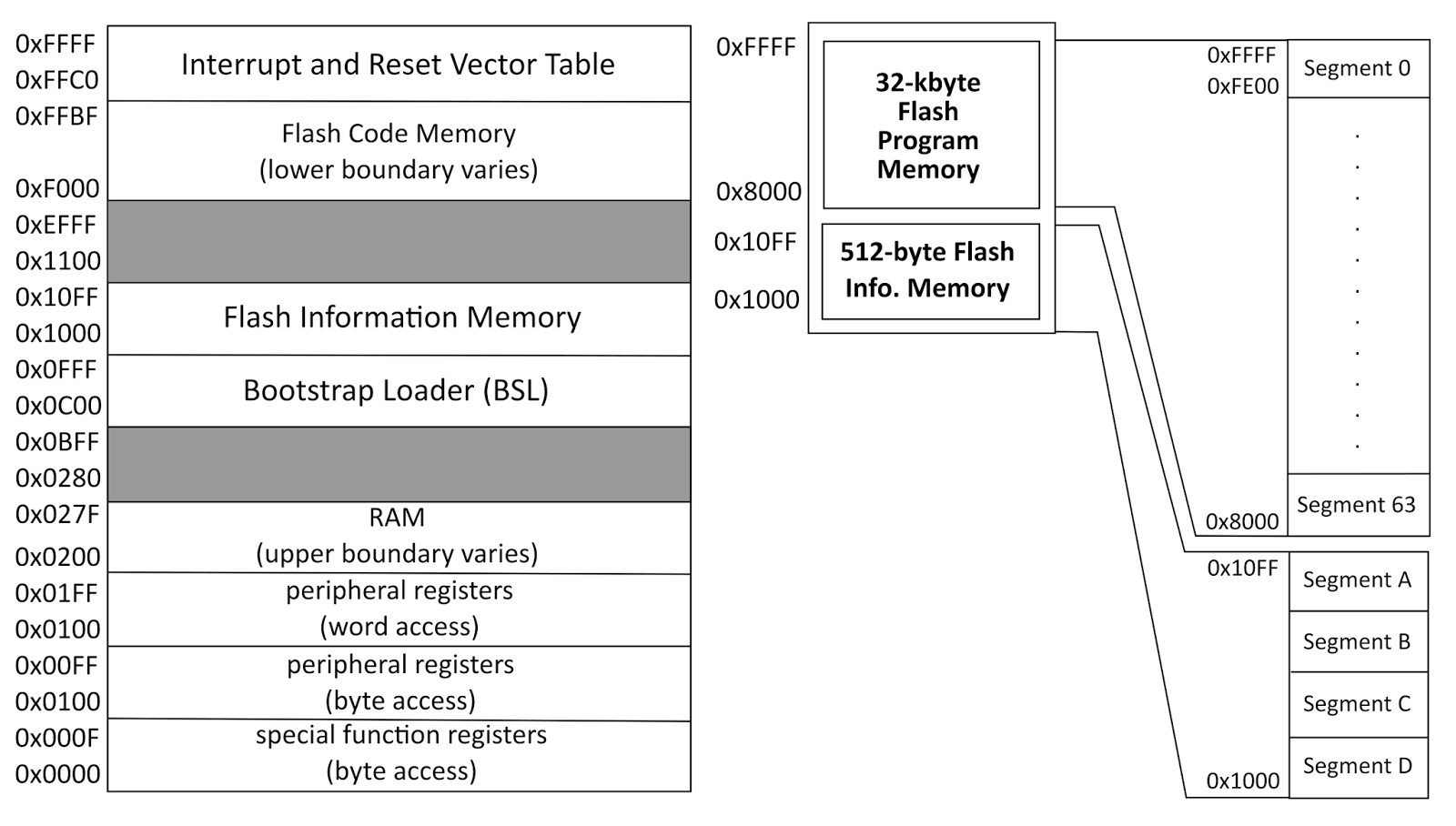
is the issue with how the BSL Utility handles the flash memory. Graphics below shows
the memory map of the MSP430 and it shows the flash memory on MSP 430 is
divided into two parts – the code memory, which contains the user code and the
information memory, which typically contains data such as calibration
constants, Digitally Controlled Oscillator (DCO) settings etc. The calibrated
DCO settings, which are required to generate accurate high speed clocks in the
MSP are stored in Segment A of the Flash Information Memory (INFO-A).
Even though the
BSL Software Utility provides an option to preserve the contents of the INFO-A
segment, it does not seem to work properly and ends up erasing the entire
information and code memory when invoked. Without the DCO constants, it is
extremely difficult to implement UART communication due to errors in the system
clock. As the bug fixes on an outdated software utility was quite a cumbersome
task, we decided to implement a hardware solution to this issue – an external
32.768 kHz crystal oscillator which can be used as an accurate clock source for
implementing UART communication. This ends up reducing the number of I/O pins
available to the user by 2 pins, but also gives the advantage of having a crystal
oscillator that can be easily used for real-time clock applications.
Here is the
complete schematic diagram of the LunchBox. It shows the power supply for the
MSP430 3.3V, derived from the 5V available on the USB connector and also
available on the output headers. The clock for the microcontroller generated
using an external crystal of 32.768 KHz frequency, connected to the Xin and
Xout pins of the MSP430. The user interface peripherals are a simple pushbutton
and an LED apart from the Reset switch. Jumpers J1 and J2 allow the user to
switch the CH340 USB to UART bridge from the MSP’s UART peripheral pins to
MSP’s BSL pins. These jumpers are manipulated manually.

An image of the LunchBox PCB layout is seen below.
As can be seen, the PCB can be fabricated as a single sided board with a few
jumpers (represented in red color) or one can get the PCB fabricated as a
double sided board through a suitable PCB manufacturer.

To enrich the learning experience, we also
developed a simple and inexpensive I/O expansion board, the Mini-Voyager (a
smaller version of the larger Voyager we have had for some time). As with the
LunchBox, the Mini-Voyager is also a single sided PCB that can be fabricated at
home or lab. The Mini-Voyager offers the user a 4-digit seven segment display,
a set of charlieplexed LEDs, an RGB LED, a capacitive touch input, a
potentiometer, an LDR and a thermistor as well as a navigation switch
configuration. The picture here shows a Mini-Voyager in the company of a LunchBox, ready
to be used.

The photograph below shows LunchBox and
Mini-Voyager in action together. More than 50 experiments and small projects
can be performed using this combination.

The MSP430 LunchBox and Mini-Voyager duo were recently used in a training program with 180 students of 5th semester of the Instrumentation and control division at NSIT and the experience with them was quite rewarding. See what they soldered and used!
 We hope to use this platform as an inexpensive way to teach about the MSP430 family of microcontrollers in future and take this package to high school students as well. If you need further details and/or help with replicating the system at your end, we would be happy to hear from you. |
Epilogue
How does one justify a BOM cost of 1$ for the LunchBox? The trick lies in ordering free samples from TI: the relevant MSP430 G series microcontroller and the LM1117 linear regulator. The only component you may need to purchase would be the CH340 USB to UART bridge and currently, this sells for 50 cents in volumes. The rest of the components are easily available in your, the electronics enthusiast's components box!